
Crazy Time Strategy: Tactical Gameplay Under Time Pressure with Fast Build-and-Execute Planning in Time-Based Strategy Games
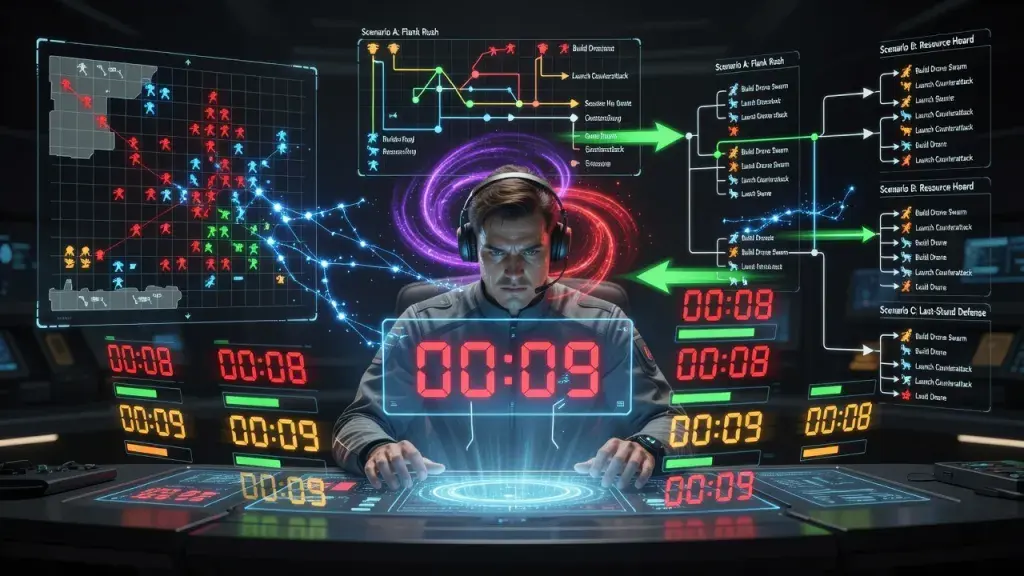
Authored by rebeldivineucc.org, 11/07/2026
A clock that never stops is a different kind of opponent than any AI or rival player. In real-time strategy titles, the countdown itself becomes the primary adversary, forcing decisions that would otherwise take minutes into windows of seconds. This is the defining tension of any time-based strategy game: resources, positioning, and timing all compete for the same narrow slice of attention, and hesitation carries a cost that no amount of raw skill can fully offset.
What separates a competent player from an exceptional one in these environments is not reaction speed alone. It is the ability to compress judgment into instinct without losing accuracy. Some players study these patterns the way analysts study market volatility, watching how quickly others adapt when the pressure spikes; there's even a growing niche of viewers who follow high-stakes formats like crazy time a strategy purely to observe how professionals structure decisions when every second is visibly running out. That crossover between entertainment and applied decision theory says something about how universal this skill actually is.
This piece breaks down what a genuine crazy time strategy looks like in practice - not as an abstract concept, but as a repeatable framework. We will look at the mental models, the sequencing logic, and the common failure points that separate players who thrive under compressed timelines from those who freeze when the pressure builds.
Understanding the Nature of Time-Based Strategy Games
Time-based strategy games differ from turn-based formats in one fundamental way: the environment keeps changing whether or not the player is ready. There is no pause button that respects indecision. Every second not spent acting is a second the opposing force - human or algorithmic - uses to gain ground.
What Makes the Clock the Real Opponent
In most competitive formats, the timer is not a background detail. It actively shapes which strategies are even viable. A plan that would work beautifully with unlimited deliberation often collapses the moment a countdown is introduced, because the player never gets to the execution phase before conditions shift.
Core Mechanics That Define the Genre
Resource accumulation, unit deployment, map control, and reactive counterplay form the backbone of nearly every time-based strategy game. What changes from title to title is the ratio between planning time and action time - and that ratio dictates how aggressive or conservative a viable strategy needs to be.
Why Pressure Changes Decision Quality
Cognitive research on decision-making under constraint consistently shows that people default to simpler heuristics when time shrinks. This is not a weakness unique to inexperienced players - it is a structural feature of how the brain allocates attention. Understanding this in advance lets a player design routines that work with this tendency instead of fighting it.
The Psychology of Tactical Gameplay for Time Pressure
Pressure does not affect all players equally, and the difference usually comes down to preparation rather than natural talent.
Cognitive Load and Decision Fatigue
Every additional variable a player must track consumes mental bandwidth. Under time pressure, that bandwidth shrinks further, which means unnecessary complexity in a plan becomes a liability rather than a strength. Simplifying decision trees ahead of time frees up capacity for the moments that actually require judgment.
Pattern Recognition as a Speed Tool
Experienced players rely less on calculation and more on recognition. They have seen a given configuration before, and they know the response that historically works. This is why repeated exposure to similar scenarios - through practice or review - builds speed far more reliably than trying to think faster in the moment.
Managing the Instinct to Freeze
- Pre-commit to a default action when uncertainty is high, rather than searching for a perfect move
- Break the countdown into smaller checkpoints instead of treating it as one continuous threat
- Accept that a slightly suboptimal fast decision usually outperforms a delayed optimal one
Strategic Planning Under Time Constraints: Building a Framework
Strategic planning under time constraints requires a different structure than open-ended planning. The goal is not to find the best possible move - it is to find a good enough move fast enough to matter.
Setting Priorities Before the Clock Starts
The strongest players do the bulk of their thinking before the timer even begins. They walk in with a hierarchy of objectives already ranked, so that when the countdown starts, they are executing a plan rather than building one from scratch.
The Role of Contingency Trees
A single fixed plan breaks the moment reality diverges from expectation. A contingency tree - a small set of pre-decided branches based on likely scenarios - lets a player pivot without losing time to fresh analysis.
Allocating Time Budgets to Each Phase
Just as a project manager assigns time blocks to tasks, a strategic player under a countdown should mentally assign rough time budgets: a few seconds for assessment, a longer stretch for execution, and a reserve buffer for correction. Without this structure, players tend to overspend time on the assessment phase and leave themselves with no room to act.
How to Build and Execute Strategy Quickly Without Losing Accuracy
Speed without accuracy is just noise. The real skill lies in compressing the gap between recognizing a situation and acting on it correctly.
Reducing Decision Points Through Templates
Skilled players often rely on templated openings or standard responses for common situations, which removes the need to reason from first principles every time. This is one of the most reliable ways to build and execute strategy quickly, because it converts a decision into a lookup rather than a calculation.
Sequencing Actions for Maximum Efficiency
Order matters as much as content. Executing the highest-impact action first, even if it feels less urgent, often prevents downstream complications that would otherwise consume the remaining time budget.
Using Feedback Loops Mid-Execution
A rigid plan executed blindly is fragile. Checking results at small intervals during execution - even briefly - allows for course correction without requiring a full stop-and-reassess cycle.
Applying Crazy Time Strategy Principles Across Different Game Formats
While the term originated in specific competitive contexts, the underlying crazy time strategy logic transfers across formats that share the same core tension: limited time, incomplete information, and consequences for delay.
Real-Time Strategy Titles
In classic RTS environments, the principles show up as build-order optimization, where every second spent idle is a second of lost economic growth. Players who internalize time-based decision frameworks consistently outperform those relying purely on mechanical skill.
Live Multiplayer Formats
In fast-paced multiplayer settings, the same logic applies to positioning and resource trades. The players who win consistently are rarely the fastest clickers - they are the ones who have reduced their decision-making to fewer, higher-quality choices.
Hybrid Entertainment Formats
Some entertainment-driven formats blend chance with timed decision windows, creating a hybrid space where strategic thinking still matters even though outcomes carry an element of randomness. These formats reward the same discipline: quick assessment, a pre-built decision hierarchy, and comfort with imperfect information.
Common Mistakes That Undermine Performance Under Time Pressure
Most failures under a countdown are not caused by lack of skill. They are caused by predictable, avoidable errors in preparation or mindset.
Overplanning Before the Clock Starts
Some players spend so long trying to build a perfect plan that they enter the timed phase with less mental energy than someone who prepared a simpler, flexible framework.
Chasing Perfect Information
Waiting for full clarity before acting is often the single biggest time drain. In compressed formats, acting on seventy percent certainty usually beats waiting for ninety.
Ignoring Post-Round Review
Players who never review what happened after the timer ends tend to repeat the same errors. A short, honest review - what worked, what stalled, where hesitation crept in - is one of the fastest ways to sharpen future performance.
Frequently Asked Questions
What is the fastest way to improve decision speed without sacrificing quality?
Reduce the number of variables you actively consider in the moment by pre-deciding responses to common scenarios before the timer starts. Practice with the same scenario repeatedly until the response becomes automatic rather than calculated.
Is it better to have one fixed plan or multiple flexible options ready?
Multiple flexible options structured as a small contingency tree consistently outperform a single fixed plan, because real situations rarely unfold exactly as anticipated. Keep the tree small - three or four branches at most - so it stays usable under pressure.
How much of strategy under time pressure is mental versus mechanical skill?
The mental component - prioritization, pattern recognition, and comfort with uncertainty - typically matters more than raw mechanical speed once a baseline level of execution skill is reached. Two players with similar mechanical ability will diverge based on decision quality alone.
Why do experienced players seem calmer under a countdown?
Familiarity with a wide range of scenarios reduces the perceived novelty of any single situation, which lowers stress response. Calm is usually a byproduct of preparation, not a separate skill to be trained independently.
Can these principles apply outside of gaming contexts?
Yes. The same framework - prioritize before time starts, build contingency branches, act on sufficient rather than perfect information - applies directly to business decisions, emergency response, and any scenario with a hard deadline and incomplete data.
What is the biggest sign that a player is overthinking under time pressure?
Repeatedly reassessing the same information without taking action is the clearest indicator. If analysis continues past the point where a decision was already reasonably clear, the delay itself becomes the primary risk.