
Gambling Age Requirements: Legal Age Limits, Minimum Eligibility, and Casino Gambling Law Restrictions
Authored by rebeldivineucc.org, 14/08/2026
A twenty-year-old college student can buy a lottery ticket in one state, get turned away from a riverboat casino two hours later, and legally place a sports bet on their phone the same night. None of this is a contradiction. It is simply how gambling law works in a country where age thresholds shift depending on the game, the venue, and the jurisdiction issuing the license. The patchwork looks confusing from the outside, but it follows a logic rooted in risk classification, state sovereignty, and decades of regulatory trial and error.
Anyone who has tried to plan a casino trip, place a wager online, or simply understand why a friend was carded at a bingo hall has run into the same wall: there is no single, universal answer to the question of how old you need to be to gamble legally. The rules depend on the state, the type of gambling, and sometimes the specific operator. Readers searching for what is the gambling age often expect a one-line answer, but the real picture requires understanding several overlapping systems of regulation. This article breaks down those systems clearly, covering everything from casino floors to online sportsbooks, so the confusion gets replaced with a working understanding of the law.
What follows is not a list of trivia. It is a practical guide for gamblers, parents, casino employees, and anyone building or working in the gambling industry who needs to know exactly where the legal lines sit - and why they were drawn there in the first place.
Understanding Gambling Age Requirements in the United States
Why Age Limits Exist in Gambling Law
Gambling age restrictions did not emerge from a single federal mandate. They developed state by state, shaped by concerns about problem gambling among young adults, the financial vulnerability of people still building credit histories, and the psychological research showing that impulse control continues developing into the mid-twenties. Regulators settled on 18 or 21 as practical thresholds, treating gambling similarly to alcohol and tobacco: activities with real financial or health consequences that societies restrict until a certain level of maturity is presumed.
Federal vs. State Authority Over Gambling Ages
Unlike alcohol, where the federal government pressured states into a uniform 21-year minimum through highway funding leverage in the 1980s, gambling age requirement rules were left almost entirely to individual states. There is no federal statute setting a national minimum age for gambling. This means Congress has stayed out of the specifics, and each state legislature decides independently, which explains why neighboring states can have completely different rules for the same activity.
How Age Requirements Differ by Game Type
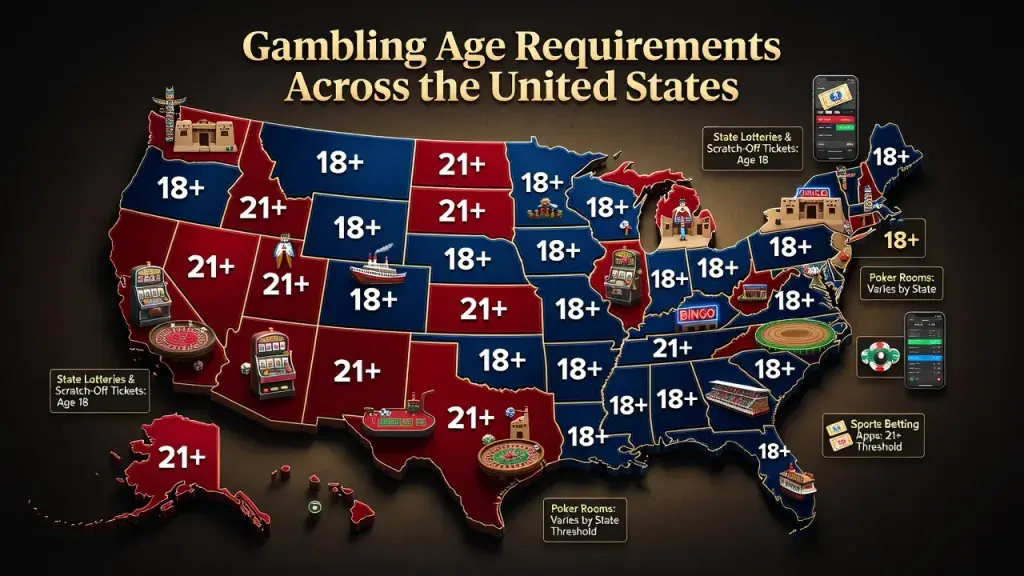
Even within a single state, the legal gambling age often depends on what you are playing. Lottery tickets and bingo frequently carry lower age minimums than commercial casino gambling, because regulators view them as lower-stakes, lower-risk products. Tribal casinos, riverboat casinos, and racetrack casinos (racinos) sometimes operate under separate rules from commercial land-based casinos, adding another layer of variation.
- State lotteries: often 18, though a handful of states set 19 or 21
- Bingo halls and charitable gaming: frequently 18
- Commercial casinos: 21 in most major gambling states
- Tribal casinos: set by tribal-state compacts, often mirroring state law but not always
- Online and mobile betting: typically matches the in-person threshold for the same activity
Legal Gambling Age by State: What the Differences Mean
States Where the Minimum Age Is 18
Several states, including Iowa, Montana, and Oklahoma for certain gaming categories, set their minimum age for gambling at 18. This applies mostly to Native American-operated casinos and pari-mutuel wagering like horse racing. The reasoning tends to align gambling age with the general age of legal adulthood, treating an eighteen-year-old as fully capable of entering binding financial contracts and therefore capable of placing a wager.
States Where the Minimum Age Is 21
Nevada, New Jersey, and most states with large commercial casino industries set the casino gambling age limit at 21. This higher bar usually correlates with the presence of alcohol service on the gaming floor. Regulators in these states have historically linked the two: if a venue serves liquor and offers house-banked table games or slot machines, the applicable age climbs to match liquor licensing standards.
Border States and the Confusion They Create
Travelers crossing from an 18-and-up state into a 21-and-up state sometimes assume the rules carry over, which they never do. A patron legally gambling in a New Mexico tribal casino at 18 cannot walk into a Colorado commercial casino and expect the same treatment. Casino security and compliance staff are trained specifically to catch this assumption, since it is one of the most common reasons underage patrons get turned away or, in rarer cases, cited.
Casino Gambling Age Limit: Land-Based vs. Online Platforms
Physical Casino Verification Practices
Land-based casinos rely on government-issued identification checked at the door, at the cashier's cage, and again at any point cash is exchanged for chips or vice versa. Surveillance teams are trained to flag guests who appear underage, and security staff have legal authority to request ID at any time on the gaming floor. Casinos face steep regulatory penalties, including license suspension, for admitting underage gamblers, which makes enforcement genuinely rigorous rather than symbolic.
Online Casino and Sportsbook Age Verification
Digital platforms cannot physically check a driver's license, so they rely on identity verification services that cross-reference names, addresses, and dates of birth against public and financial databases. Most licensed online operators also require a deposit method tied to a verified bank account or credit card, adding a secondary layer of age confirmation. Because online gambling regulation is newer than casino law, some states have written stricter age and verification rules specifically for internet wagering than for their physical casinos.
Consequences of Underage Gambling Attempts
Getting caught gambling underage rarely results in criminal prosecution for the individual, but the consequences are still real. Casinos confiscate winnings, ban the individual from the property, and in states with strict enforcement, report the incident to gaming commissions. Online operators typically freeze the account, void any winnings, and refund only the original deposit, sometimes after a lengthy investigation.
Minimum Age for Gambling Across Different Gambling Formats
Sports Betting Age Restrictions
Since the 2018 Supreme Court decision that opened sports betting to individual states, most jurisdictions that legalized it set the minimum age for gambling on sports at 21, mirroring their casino standards. A few states with otherwise lower gambling ages made an exception specifically for sports wagering, treating it as a higher-risk product due to its live, fast-paced nature and its popularity among younger adults.
Lottery and Scratch-Off Ticket Age Rules
Lottery products remain the most accessible form of legal gambling for younger adults, with the majority of states allowing purchase at 18. A small number of states, including a few in the Northeast, have pushed their lottery minimum to 21 in recent years, citing concerns about lottery-related problem gambling patterns among younger players.
Poker Rooms, Bingo, and Charitable Gaming
Poker rooms inside commercial casinos generally follow the same age limit as the rest of the casino floor. Standalone poker rooms or charitable poker events, however, sometimes fall under separate statutes allowing 18-year-old participation. Bingo and raffle-style charitable gaming almost universally carry the lowest age thresholds, often 18, reflecting their traditional association with community and religious organizations rather than commercial gambling operators.
Gambling Law Age Restrictions and Enforcement Mechanisms
How Regulators Set and Adjust Age Limits
State gaming commissions periodically review age thresholds, often in response to new data on problem gambling, public pressure following high-profile incidents, or shifts in neighboring state policy. Adjusting a legal gambling age requires legislative action, not just a regulatory decision, which is why changes tend to happen slowly and rarely without public debate.
Licensing Requirements Tied to Age Compliance
Every casino operator's license includes explicit compliance obligations around age verification. Gaming commissions conduct regular audits, sometimes using underage decoys in controlled sting operations, to confirm that ID-checking procedures are being followed consistently. A pattern of violations can lead to fines that scale into six figures or, in repeated cases, suspension of the gaming license itself.
Penalties for Casinos That Violate Age Restrictions
Beyond fines, casinos caught repeatedly serving underage gamblers face reputational damage that can affect their standing with state regulators during license renewal periods. Individual employees who knowingly wave through underage patrons can lose their gaming credentials permanently, which functions as a career-ending penalty in an industry where employment requires state licensing.
Practical Guidance for Gamblers and Casino Staff
How to Confirm the Legal Age Before You Play
The most reliable approach is checking directly with the specific casino or platform, since state minimums can be modified by tribal compacts, local ordinances, or operator-specific policy that sets a stricter internal standard than the law requires. Calling ahead or reviewing a casino's published terms saves the embarrassment of being turned away after traveling.
What Casino Employees Are Trained to Look For
Dealers, pit bosses, and security staff are trained to check identification for anyone who appears younger than roughly 30, a standard buffer used across the industry to avoid close judgment calls. They also watch for shared or borrowed identification, a common tactic among underage patrons attempting to bypass the casino gambling age limit.
Advice for Parents and Guardians
Parents underestimate how early gambling exposure can happen, often through family lottery habits, informal betting pools, or unsupervised access to a relative's online betting account. Open conversation about the reasoning behind gambling law age restrictions tends to be more effective than blanket prohibition, since curiosity without context is what typically drives risky experimentation once a young adult reaches legal age.
Frequently Asked Questions
Is the legal gambling age the same in every U.S. state?
No. It varies by state and by the type of gambling activity. Some states set 18 as the minimum for most gaming, while others, particularly those with large commercial casino industries, require players to be 21.
Can an 18-year-old gamble at a tribal casino if the state minimum is 21?
It depends on the specific tribal-state gaming compact. Some tribal casinos set their own age minimum at 18 even when the surrounding state's commercial casinos require 21, so checking with the specific property is essential before visiting.
Why do casinos set the age limit at 21 instead of 18?
The 21-year threshold is usually tied to alcohol service on the gaming floor. Since most commercial casinos serve liquor, they align their gambling age with liquor licensing laws rather than setting a separate standard.
Does online sports betting follow the same age rules as physical casinos?
In most states, yes - online sportsbooks match the minimum age required for in-person betting in that state. A few states have set the online threshold slightly differently, so confirming the specific platform's terms is the safest approach.
What happens if someone underage is caught gambling in a casino?
Casinos typically confiscate any winnings, ban the individual from the property, and may report the incident to state gaming regulators. Criminal charges against the individual are uncommon, but the casino itself can face fines or license consequences for allowing the violation to occur.
Are lottery tickets subject to different age rules than casino games?
Yes. Lottery and scratch-off tickets often have a lower minimum age, commonly 18, even in states where casino gambling requires players to be 21. A small number of states have raised their lottery age to 21 in recent years.