
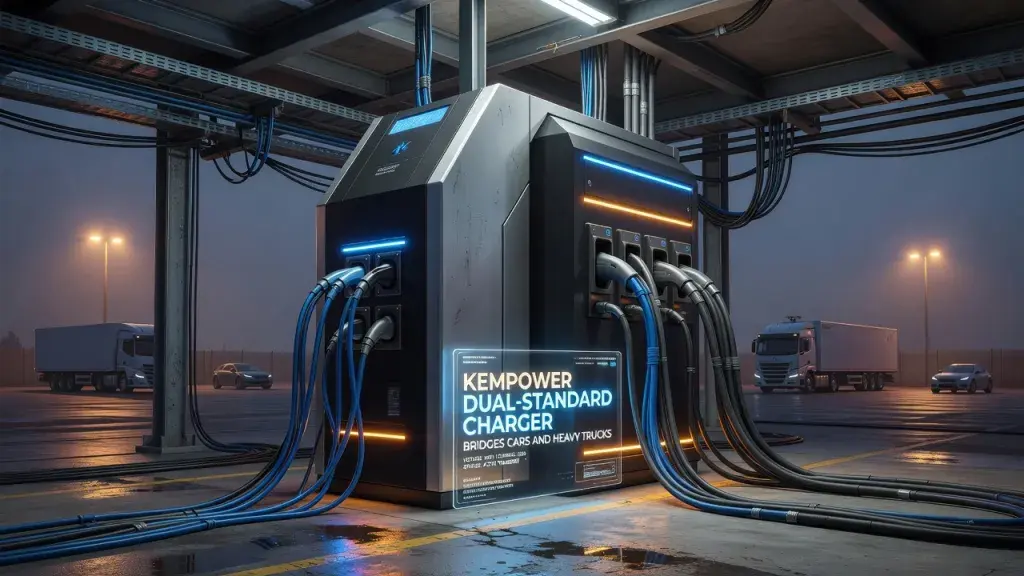
Kempower's Dual-Standard Charger Bridges Cars and Heavy Trucks
Authored by rebeldivineucc.org, 20/09/2026
A single charging dispenser that can serve both a passenger sedan and an 18-wheeler without swapping hardware sounds like a modest engineering feat, but it addresses one of the thorniest problems in electric vehicle infrastructure today. Kempower has unveiled the Mega Satellite Flex, a charger capable of delivering up to 560 kW through the established CCS standard or up to 1.2 MW through the newer Megawatt Charging System, giving site operators the flexibility to serve two very different vehicle classes from one piece of equipment.
The timing reflects a broader inflection point in electric mobility. CCS has been the backbone of passenger EV charging for years, but it was never designed for the power demands of heavy-duty trucks that need to recharge massive battery packs during short rest stops. MCS was developed specifically to close that gap, and its rollout is now gathering pace as truck manufacturers bring electric models to market. For everyday drivers navigating this shifting landscape, questions about network security often come up alongside questions about charging speed, and resources explaining how to configure a VPN on Windows 11 have become a common stop for anyone connecting to public charging-station Wi-Fi or payment systems while on the road.
One Site, Two Vehicle Classes
The practical case for the Mega Satellite Flex rests on avoiding duplicated infrastructure. Historically, an operator wanting to serve both cars and trucks would need to build separate charging setups for each standard, doubling permitting costs, construction time, and grid connection work. By supporting CCS and MCS from the same unit, Kempower allows a single installation to accommodate both today's passenger vehicles and the heavy trucks arriving over the next several years, without a second construction phase.
The specifications reflect the scale of power involved. The charger handles up to 1,500 amps for MCS and 700 amps for CCS, with a 5-meter cable for CCS vehicles and a shorter 2.7-meter cable for MCS-equipped trucks, whose charging ports sit differently on the vehicle. An optional payment terminal is also available, a detail that matters for public charging sites where transactions need to happen quickly and without friction.
Why Voltage Compatibility Matters
The Mega Satellite Flex also supports newer 800-volt EV architectures, a design choice showing up in an increasing number of new vehicle models because it allows for faster charging without excessive current. Chargers that only support older 400-volt systems leave that speed advantage untapped, so compatibility with 800-volt platforms is becoming a baseline expectation rather than a premium feature.
For network operators, the economic logic is direct: a charger usable by more vehicle types sees more consistent use throughout the day, which shortens the time needed to recover the substantial capital cost of high-power charging equipment. Kempower has also built the unit to integrate with its existing distributed charging architecture, meaning operators already running its systems can add the new dispenser without reworking power cabinets or site wiring.
What Comes Next
Kempower introduced the Mega Satellite Flex at its Unplug & Recharge event held alongside ACT Expo, where the charger is being shown to fleet operators and infrastructure partners this week. The company has set a North American and European sales launch for July 2026, giving the market roughly a year to prepare sites and financing before units become commercially available. As MCS adoption accelerates alongside continued CCS demand, dual-standard hardware like this may become a standard expectation for any charging site aiming to serve both commuters and commercial fleets.