
How to Choose Luxury Gold Gemstone Jewelry: Gold Gemstone Rings, Stones, and the Gold Gemstone Casting Process
Authored by rebeldivineucc.org, 11/07/2026
A ring loses its shape faster than most buyers realize. Gold softens under heat, gemstones shift under pressure, and a poorly cast setting can loosen a stone within a year of daily wear. Yet the market for gemstone gold jewelry keeps growing, driven by buyers who want something that outlasts a passing trend and holds real material value. The problem is that most shoppers evaluate these pieces on appearance alone, ignoring the metallurgy and craftsmanship that determine whether a ring survives a decade or falls apart in months.
Choosing well requires understanding three separate disciplines at once: the properties of gold alloys, the physical and optical characteristics of gemstones, and the casting techniques that bind them together. Get any one of these wrong, and the piece fails, sometimes visibly, sometimes in ways that only show up after years of wear. For collectors curious about how these elements come together digitally before they ever reach a jeweler's bench, some platforms even offer a visual preview experience, such as the gemstones gold demo, which illustrates how faceted stones interact with gold settings under different lighting conditions. That kind of preview has no bearing on metallurgy, but it does help train the eye for proportion and color contrast before a real purchase.
This guide walks through the practical decisions that separate a lasting investment from an expensive disappointment, covering everything from karat selection to the casting techniques used to secure each stone.
Understanding Gold Purity and Its Role in Gemstone Settings
Karat Ratings Explained
Gold purity is measured in karats, with 24k representing pure gold and lower numbers indicating an alloy mixed with metals like copper, silver, or palladium. Pure gold is soft - too soft to hold a gemstone securely under daily friction and impact. This is why almost all gemstone gold jewelry uses 14k or 18k gold, striking a balance between purity and structural integrity. An 18k ring contains 75% gold and offers a warmer, richer color, while 14k gold, at 58.3% gold content, resists scratching and bending more effectively.
How Alloy Composition Affects Durability
The metals mixed into gold alter more than color. Nickel alloys increase hardness but can trigger skin reactions in sensitive wearers. Palladium alloys produce a bright white finish without the allergenic risk of nickel, which is why palladium white gold has become the standard for luxury gold gemstone pieces set with colorless stones like diamonds. Copper-heavy alloys create rose gold tones and add resilience, making them a practical choice for rings worn daily.
Matching Gold Color to Gemstone Type
Yellow gold intensifies the warmth of amber, citrine, and yellow sapphire, while white gold sharpens the cool tones of aquamarine, tanzanite, and blue sapphire. Rose gold pairs well with morganite and pink tourmaline, since the metal's pink undertone amplifies the stone's own coloring rather than competing with it. A mismatch doesn't ruin a piece, but it does mute the visual impact a well-chosen combination can achieve.
Selecting the Right Gemstones for Luxury Jewelry
Precious vs. Semi-Precious Stones
Diamonds, rubies, sapphires, and emeralds fall into the traditional precious category, prized for hardness and rarity. Semi-precious stones - amethyst, topaz, garnet, peridot - offer striking color at a fraction of the cost and, in many cases, comparable durability. The distinction matters less for wearability than buyers assume; a well-cut garnet can outperform a poorly cut sapphire in everyday use.
Evaluating Clarity, Cut, and Color
Clarity refers to internal inclusions, cut determines how light reflects through the stone, and color affects both aesthetic appeal and market value. Of the three, cut has the largest visible impact on a finished ring. A shallow or overly deep cut leaks light out the bottom of the stone, leaving it lifeless even if the clarity grade is excellent.
Stone Hardness and Everyday Wearability
The Mohs hardness scale ranks gemstones from 1 (talc) to 10 (diamond). Stones below 7, such as opal, pearl, or emerald, scratch easily and need protective settings - often a bezel rather than an exposed prong. Anyone building a gold and gemstone collection meant for daily wear should prioritize stones rated 7 or higher, reserving softer stones for pendants and earrings that see less friction.
- Diamond (10) - exceptional durability, ideal for daily-wear rings
- Sapphire and Ruby (9) - strong resistance to scratching and chipping
- Topaz and Emerald (7.5-8) - durable but prone to internal fractures under impact
- Opal and Pearl (3-6) - decorative stones requiring careful, low-impact settings
Choosing the Perfect Gold Gemstone Ring
Setting Styles: Prong, Bezel, and Pave
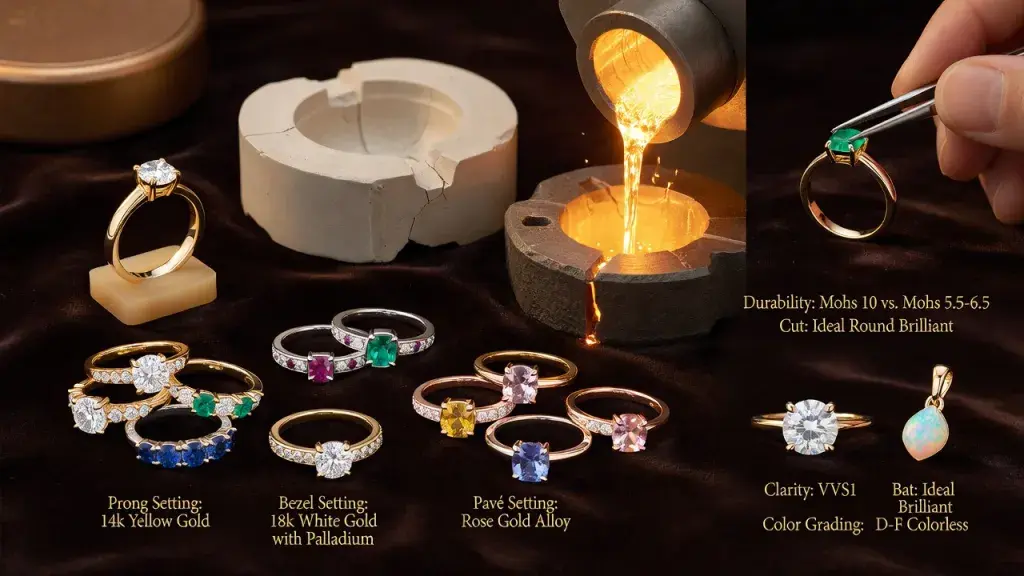
Prong settings expose more of the stone to light, maximizing brilliance but offering less physical protection. Bezel settings encircle the stone in a metal rim, sacrificing some visibility for significantly better durability. Pave settings use small stones set close together across the band, creating texture and sparkle but requiring more maintenance since multiple tiny prongs are involved.
Sizing and Comfort for Daily Wear
Ring sizing affects more than comfort - it affects the longevity of the setting itself. A ring that's too loose slides around the finger, causing the stone to strike surfaces repeatedly. Comfort-fit bands, slightly rounded on the interior, reduce pressure points and are worth the modest price premium for anyone planning to wear their gold gemstone rings daily.
Matching Ring Design to Lifestyle
An active lifestyle calls for low-profile settings that won't catch on clothing or equipment. Office or formal settings allow for taller, more dramatic mountings. Buyers often choose a design based on appearance alone, then discover within weeks that the setting doesn't suit their daily routine - a mismatch that proper planning avoids entirely.
The Gemstone Gold Casting Process Explained
Wax Modeling and Mold Creation
Every cast piece begins as a wax model, either hand-carved or produced through 3D printing from a digital file. The wax model is invested in plaster, then heated until the wax melts and burns away, leaving a hollow cavity in the exact shape of the intended piece. This lost-wax method has remained the foundation of gemstone gold casting for centuries, refined but not fundamentally replaced by modern technology.
Pouring and Solidifying the Gold Alloy
Molten gold alloy, heated well above its melting point, is poured or injected into the mold under controlled pressure to ensure it fills every detail, including fine filigree and prong structures. As the metal cools, it solidifies into the exact shape of the original wax model. Temperature control during this stage determines the final grain structure of the metal, which in turn affects strength and finish quality.
Stone-Setting After Casting
Gemstones are almost never cast directly into molten gold, since the heat would damage or shatter most stones. Instead, settings are cast with slightly undersized prongs or bezels, and stones are set by hand afterward, with the metal gently pushed or hammered into place around each gem. This separation between casting and setting is what allows jewelers to combine delicate stones with durable gold structures safely.
Quality Control and Finishing Techniques
After casting, pieces go through filing, polishing, and sometimes rhodium plating to achieve a flawless surface. Inspectors check for porosity - small air bubbles trapped during casting that weaken the metal - since porous gold is more prone to cracking under stress. A rigorous finishing process is often the clearest sign of a workshop capable of producing genuinely luxury gold gemstone pieces rather than mass-market approximations.
Building and Maintaining a Gold and Gemstone Collection
Diversifying Metal Tones and Stone Types
A well-rounded collection mixes metal colors and stone varieties rather than repeating the same combination. Pairing yellow gold pieces with warm stones, white gold with cool stones, and reserving rose gold for softer pastel gems creates a wardrobe of jewelry that adapts to different outfits and occasions instead of a single repetitive look.
Storage and Care to Preserve Value
Gemstones scratch each other when stored loosely together, and gold surfaces dull from repeated contact with other jewelry. Individual soft pouches or compartmentalized boxes prevent this kind of damage. Cleaning should match the specific stone - ultrasonic cleaners work well for diamonds and sapphires but can fracture emeralds and opals, which require gentle manual cleaning instead.
Insuring and Appraising Valuable Pieces
Any serious gold and gemstone collection benefits from periodic professional appraisal, since gold prices fluctuate and gemstone values shift with market demand. Insurance riders specific to jewelry, rather than generic homeowner's coverage, typically provide better protection against loss, theft, or damage, particularly for pieces that combine rare stones with substantial gold weight.
Frequently Asked Questions
What karat gold is best for a ring worn every day?
14k gold is generally the better choice for daily wear since its higher alloy content resists scratching and bending more effectively than 18k. If color richness matters more than durability, 18k remains workable as long as the wearer accepts slightly more maintenance over time.
Can any gemstone be safely set through casting?
No. Heat-sensitive stones like opal, pearl, and emerald cannot withstand the casting process and must be set by hand afterward into a pre-formed setting. Only extremely heat-resistant stones, and even then rarely, are ever exposed to casting temperatures directly.
How do I know if a gemstone gold ring has good craftsmanship?
Examine the setting under magnification for even prong spacing, a smooth polish free of pitting, and a stone that sits flush without wobbling. Porosity, visible seams, or uneven metal thickness usually indicate rushed casting or inadequate finishing.
Is white gold or platinum better for setting diamonds?
Platinum is denser and holds prongs more securely over decades, making it the preferred choice for heirloom pieces, though it costs considerably more than white gold. White gold with palladium alloy offers nearly comparable performance at a lower price, making it the practical choice for most luxury gold gemstone rings.
How often should gemstone jewelry be professionally checked?
An annual inspection catches loose prongs, worn settings, and early metal fatigue before a stone falls out or gets damaged. Pieces worn daily, particularly rings, benefit from more frequent checks since they absorb the most physical stress of any jewelry category.
Does a larger gemstone always mean higher value?
Not necessarily. A smaller stone with excellent clarity, cut, and color can be worth more than a larger stone with visible inclusions or a poor cut. Value depends on the combination of all four traditional grading factors, not size alone.